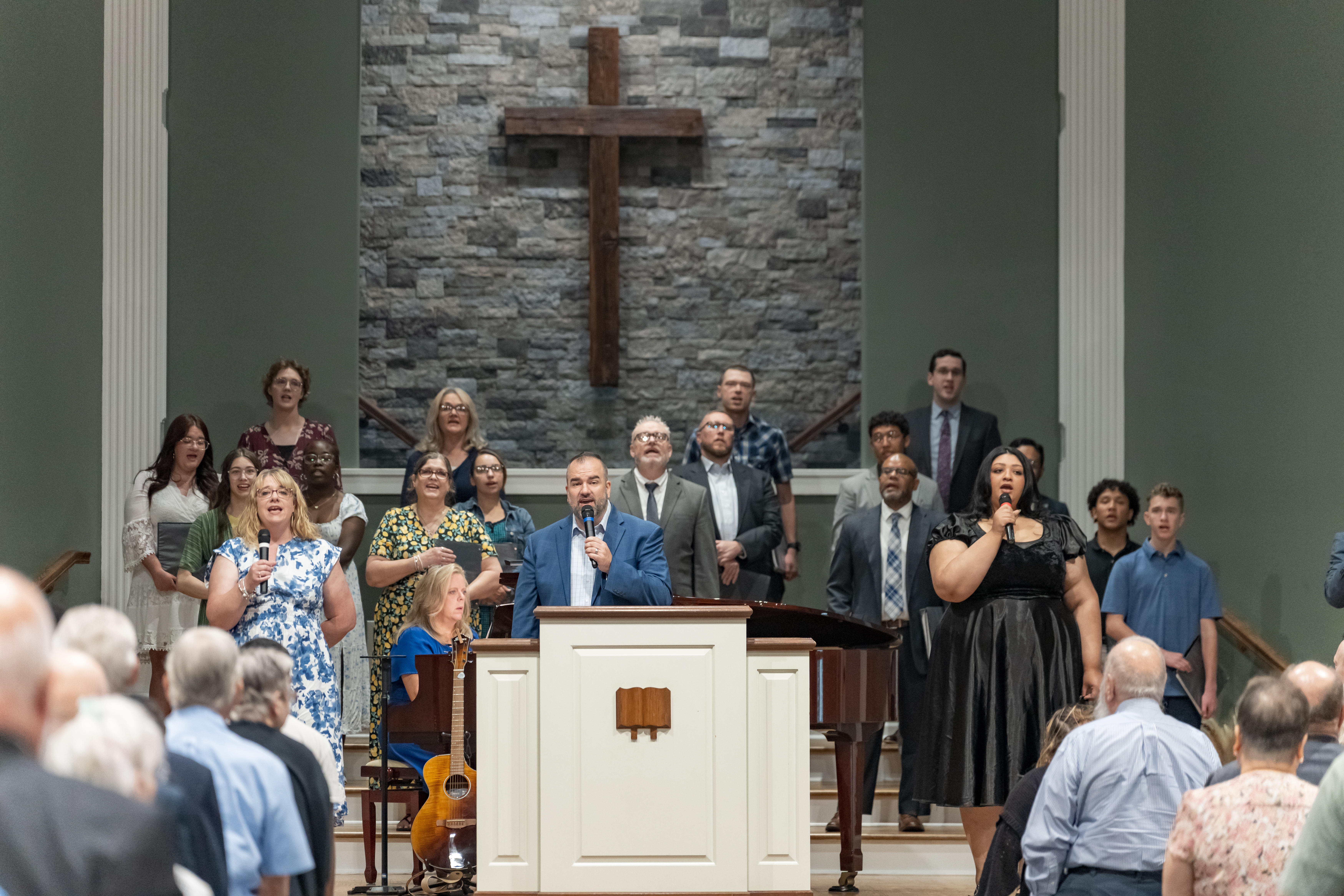
Songs Worth Singing

Brad O'DellDeacon
July 16, 2026

7 Minute Read

Colossians 3:16
Let the word of Christ dwell in you richly in all wisdom; teaching and admonishing one another in psalms and hymns and spiritual songs, singing with grace in your hearts to the Lord.

There is something powerful that happens when a congregation sings together.

But not all songs do that well. And that is worth thinking about.

This is not an argument for one style over another. It is not a case for the old against the new, or the traditional against the contemporary. It is simply an invitation to take seriously what Paul told the church at Colossae, that the songs we sing are meant to let the word of Christ dwell in us richly.

The question worth asking is not how old is this song?

It is how much of Christ is in it?

God's Design for Congregational Singing

Paul's instruction in Ephesians 5:19 gives us a remarkably broad category for worship music, “Speaking to yourselves in psalms and hymns and spiritual songs, singing and making melody in your heart to the Lord.”

That breadth is intentional.

Congregational singing should not be confined to a single style, era, or form. It should be rich, varied, and full, much like the Psalms themselves, which range from triumphant praise to gut-honest lament, from quiet trust to thunderous declaration.

What unifies that variety is not style.

It is substance.

Every psalm, every hymn, every spiritual song is meant to carry the weight of truth and direct the heart toward God. When a song does that well, whatever its form, it belongs in the worship of God's people.

What Great Songs Do

Whether a song was written in the eighteenth century or last year, the best worship songs share certain qualities. They are worth looking for, and worth protecting.

1) They are anchored in Scripture.

The greatest songs the church has ever sung draw their content from the Word of God. They are not vague impressions about a generic higher power. They are specific declarations about the God of the Bible, the cross of Christ, the grace that saves, the hope that holds. When a song is saturated with Scripture, it does more than entertain.

It instructs.

2) They teach as they are sung.

Paul connects singing directly to teaching and admonishing one another in Colossians 3:16. That means congregational singing is not a passive experience. It is a corporate act of edification.

When the words are theologically grounded, the congregation is being built up every time they sing them, whether they realize it or not.

3) They engage both the heart and the mind.

Paul's standard in 1 Corinthians 14:15 is clear, “I will sing with the spirit, and I will sing with the understanding also.”

The best songs stir genuine emotion because they are rooted in genuine truth. Feeling and doctrine are not enemies in worship.

They are meant to travel together.

4) They point to Christ, not to the experience of worship itself.

There is a subtle but important difference between a song that says look at what God has done and one that says look at how I feel about God.

Both have their place. But a steady diet of the latter can quietly shift the center of worship from the Savior to the worshipper. Songs that keep Christ at the center, His person, His work, His glory, do the most lasting good.

The Gift of the Historic Hymns

It would be a real loss to walk away from the great hymns of the faith, not because they are old, but because they are extraordinarily good at doing what congregational singing is meant to do.

The men and women who wrote them were not simply poets. They were theologians with a pastoral burden.

  • Isaac Watts wanted truth to be singable.
  • Charles Wesley believed every doctrine deserved to be sung.
  • Fanny Crosby, blind from infancy, wrote thousands of hymns because she had seen something with the eyes of faith that she could not stop putting into words.

Open a hymn like And Can It Be and you will find the incarnation, the atonement, the new birth, and the assurance of salvation — all developed across five stanzas.

Sing It Is Well With My Soul and you are singing words written by a man who had just lost his four daughters at sea. Those words have steadied grieving believers ever since, because they were already planted in the memory, already true.

That kind of depth is a gift. And it is a gift worth passing on to the next generation, not as a museum piece, but as a living inheritance.

The Value of Newer Songs

At the same time, God has not stopped inspiring His people to write.

There are songs being sung today that are rich in doctrine, saturated in Scripture, and genuinely Christ-centered. When a newer song meets that standard, it deserves a place in our worship just as much as any hymn written centuries ago.

The issue was never the age of the song.

The issue is always the content.

A theologically empty hymn from 1750 does less for the congregation than a doctrinally rich song written last decade. What we are after is not the preservation of an era, it is the presence of truth.

Why Balance Matters

A healthy worship diet includes both old and new, and here is why:

The older songs anchor us. They connect us to the faith of a long line of believers who trusted the same God before us. They remind us that we did not invent this faith, we received it.

The newer songs remind us the gospel is still alive. They reflect a faith that is not frozen in the past but active in the present, still moving hearts, still producing fruit, still being proclaimed in every generation.

Together, they give the congregation something full and balanced, a worship life that is rooted in history and alive in the present.

Singing With Understanding

When the lyrics appear on the screen, resist the urge to simply wait for the music to cue you in.

Read the words first.

Let them land as statements of faith before they become songs of worship. Ask yourself:

  • What is this saying about God?
  • Do I believe this?
  • What is this calling me to remember or do?

That simple habit turns singing from a passive activity into an act of genuine, engaged worship, which is exactly what God is after.

John 4:24
God is a Spirit: and they that worship him must worship him in spirit and in truth.

A Word Before You Leave Your Seat

The songs we sing together are not filler between the announcements and the sermon.

They are a vital part of what happens when the church gathers. They teach us. They anchor us. They give us a shared language for expressing faith, grief, hope, and praise. They plant truth in us that surfaces at exactly the right moment, in a hospital room, in a sleepless night, when we need it most.

So sing.

Sing the old songs and mean them.
Sing the newer songs and let them do their work.
Sing with your whole heart and your whole mind.

And let the word of Christ dwell in you richly, not just while the music plays, but long after you leave your seat.

1 Corinthians 14:15
I will sing with the spirit, and I will sing with the understanding also.


At Faith Baptist Church, we are committed to worship that is rooted in Scripture, balanced in expression, and directed wholly to the glory of God — because the songs we sing shape what we believe.

Up Next
From this Collection: Worship Ministry
Currently Reading
July 16, 20267 Minute Read
Songs Worth Singing
Colossians 3:16 Let the word of Christ dwell in you richly in all wisdom; teaching and admonishing one another in psalms and hymns and spiritual songs, singing with grace in your hearts to the Lord. There is something powerful that happens when a congregation sings together. But not all songs do that well. And that is worth thinking about. This is not an argument for one style over another. It is not a case for the old against the new, or the traditional against the contemporary. It is simply an invitation to take seriously what Paul told the church at Colossae, that the songs we sing are meant to let the word of Christ dwell in us richly. The question worth asking is not how old is this song? It is how much of Christ is in it? God's Design for Congregational Singing Paul's instruction in Ephesians 5:19 gives us a remarkably broad category for worship music, “Speaking to yourselves in psalms and hymns and spiritual songs, singing and making melody in your heart to the Lord.” That breadth is intentional. Congregational singing should not be confined to a single style, era, or form. It should be rich, varied, and full, much like the Psalms themselves, which range from triumphant praise to gut-honest lament, from quiet trust to thunderous declaration. What unifies that variety is not style. It is substance. Every psalm, every hymn, every spiritual song is meant to carry the weight of truth and direct the heart toward God. When a song does that well, whatever its form, it belongs in the worship of God's people. What Great Songs Do Whether a song was written in the eighteenth century or last year, the best worship songs share certain qualities. They are worth looking for, and worth protecting. 1) They are anchored in Scripture. The greatest songs the church has ever sung draw their content from the Word of God. They are not vague impressions about a generic higher power. They are specific declarations about the God of the Bible, the cross of Christ, the grace that saves, the hope that holds. When a song is saturated with Scripture, it does more than entertain. It instructs. 2) They teach as they are sung. Paul connects singing directly to teaching and admonishing one another in Colossians 3:16. That means congregational singing is not a passive experience. It is a corporate act of edification. When the words are theologically grounded, the congregation is being built up every time they sing them, whether they realize it or not. 3) They engage both the heart and the mind. Paul's standard in 1 Corinthians 14:15 is clear, “I will sing with the spirit, and I will sing with the understanding also.” The best songs stir genuine emotion because they are rooted in genuine truth. Feeling and doctrine are not enemies in worship. They are meant to travel together. 4) They point to Christ, not to the experience of worship itself. There is a subtle but important difference between a song that says look at what God has done and one that says look at how I feel about God. Both have their place. But a steady diet of the latter can quietly shift the center of worship from the Savior to the worshipper. Songs that keep Christ at the center, His person, His work, His glory, do the most lasting good. The Gift of the Historic Hymns It would be a real loss to walk away from the great hymns of the faith, not because they are old, but because they are extraordinarily good at doing what congregational singing is meant to do. The men and women who wrote them were not simply poets. They were theologians with a pastoral burden. Isaac Watts wanted truth to be singable. Charles Wesley believed every doctrine deserved to be sung. Fanny Crosby, blind from infancy, wrote thousands of hymns because she had seen something with the eyes of faith that she could not stop putting into words. Open a hymn like And Can It Be and you will find the incarnation, the atonement, the new birth, and the assurance of salvation — all developed across five stanzas. Sing It Is Well With My Soul and you are singing words written by a man who had just lost his four daughters at sea. Those words have steadied grieving believers ever since, because they were already planted in the memory, already true. That kind of depth is a gift. And it is a gift worth passing on to the next generation, not as a museum piece, but as a living inheritance. The Value of Newer Songs At the same time, God has not stopped inspiring His people to write. There are songs being sung today that are rich in doctrine, saturated in Scripture, and genuinely Christ-centered. When a newer song meets that standard, it deserves a place in our worship just as much as any hymn written centuries ago. The issue was never the age of the song. The issue is always the content. A theologically empty hymn from 1750 does less for the congregation than a doctrinally rich song written last decade. What we are after is not the preservation of an era, it is the presence of truth. Why Balance Matters A healthy worship diet includes both old and new, and here is why: The older songs anchor us. They connect us to the faith of a long line of believers who trusted the same God before us. They remind us that we did not invent this faith, we received it. The newer songs remind us the gospel is still alive. They reflect a faith that is not frozen in the past but active in the present, still moving hearts, still producing fruit, still being proclaimed in every generation. Together, they give the congregation something full and balanced, a worship life that is rooted in history and alive in the present. Singing With Understanding When the lyrics appear on the screen, resist the urge to simply wait for the music to cue you in. Read the words first. Let them land as statements of faith before they become songs of worship. Ask yourself: What is this saying about God? Do I believe this? What is this calling me to remember or do? That simple habit turns singing from a passive activity into an act of genuine, engaged worship, which is exactly what God is after. John 4:24 God is a Spirit: and they that worship him must worship him in spirit and in truth. A Word Before You Leave Your Seat The songs we sing together are not filler between the announcements and the sermon. They are a vital part of what happens when the church gathers. They teach us. They anchor us. They give us a shared language for expressing faith, grief, hope, and praise. They plant truth in us that surfaces at exactly the right moment, in a hospital room, in a sleepless night, when we need it most. So sing. Sing the old songs and mean them. Sing the newer songs and let them do their work. Sing with your whole heart and your whole mind. And let the word of Christ dwell in you richly, not just while the music plays, but long after you leave your seat. 1 Corinthians 14:15 I will sing with the spirit, and I will sing with the understanding also. At Faith Baptist Church, we are committed to worship that is rooted in Scripture, balanced in expression, and directed wholly to the glory of God — because the songs we sing shape what we believe.

May 17, 20264 Minute Read
Show Us Christ
The Story “Show Us Christ reminds us that the purpose of preaching God’s Word is not simply to give insights for living, impress people with our knowledge, or to tell people they need to try harder. The primary goal is to display the glory of God in the face of Jesus Christ. The written and preached Word is meant to point us to the riches of the living Word. And because we need the Holy Spirit to open our eyes to the glory of Christ in Scripture, it’s right and good that we ask God for help to do just that." (Bob Kauflin, writer “Show Us Christ”) Scriptural Application We sing about many aspects of our faith: giving glory to God, retelling the wondrous story of the Gospel, celebrating the life, death, and resurrection of Jesus, expressing our love for God and dependence on His grace and mercy. They are all Scripturally-based songs, but how often do we sing songs that ask God to transform us by His powerful Word? This simple yet beautiful song is a humble prayer of preparation and begging God to impress His Word upon our hearts by the power of His Spirit in such a way that our lives bear the fruit of the Gospel as a response. At the heart of this prayer is the centrality of Christ. What great privilege we have as Christians on this side of the Cross, with the joy of seeing Christ as the fulfillment of God’s written Word (Matt 5:17) and the very Word of God in flesh (John 1:14). We should never take for granted the fact that God has chosen to reveal Himself to us in the Bible. Neither should we ever trust in our ability to properly understand His revelation apart from the discernment given by His Holy Spirit (1 Corinthians 2:14). The fact that the "experts" on the Old Testament missed the coming of the Messiah, despite devoting their entire lives to studying God's Word, should serve as a warning against coming to the Scriptures on our own terms. Yet God has promised that He Himself will give us understanding (2 Timothy 2:7). And so we pray for open eyes and hearts, both for ourselves and for others (Psalm 119:144; Colossians 1:9). We confess our need for God to give us the growth that we desire (Mark 4:14-20; 1 Corinthians 3:7), and to help our unbelief (Mark 9:24). We claim the unmatched ability of God's Word to make us wise (Psalm 119:130), to feed our souls (Job 23:12; Matthew 4:4), and to impart to us the riches of His knowledge (Romans 11:33). And when the Bible seems hard to understand and ever harder to apply, we must acknowledge that we have nowhere else to turn, and express our trust that God's Word will give us the direction and discernment we need in our lives. (John 6:66-68; Philippians 2:9-11). This is a perfect song to sing before hearing God’s Word preached. The truth is, we need God’s help to prepare our hearts, give us the ears to hear, and hearts to understand and apply His Word. With so many worldly voices competing for our attention, we must cling to God’s voice, spoken to us in His living Word. For as the disciples recognized: “Lord, to whom shall we go? thou hast the words of eternal life. And we believe and are sure that thou art that Christ, the Son of the living God.” (John 6:68-69). Lyrics Verse 1 Prepare our hearts, O God, help us to receive Break the hard and stony ground, help our unbelief Plant your Word down deep in us, cause it to bear fruit Open up our ears to hear, lead us in Your truth Chorus Show us Christ, Show us Christ O God, reveal Your glory through the preaching of Your Word Until every heart confesses Christ is Lord Verse 2 Your Word is living light upon our darkened eyes Guards us through temptations, makes the simple wise Your Word is food for famished ones, freedom for the slave Riches for the needy soul, come speak to us today Bridge Where else can we go, Lord? Where else can we go? You have the words of eternal life!
May 17, 20265 Minute Read
God the Uncreated One
The Story This modern hymn - alternately titled "God the Uncreated One" and "King Forevermore” - was written by Aaron Keyes and Pete James. "'Kingdoms rise and kingdoms fall, he is faithful through it all' is a timely reminder for us. Our God, who was, is, and is to come, is actively working in our world. As beautifully as he hung the stars in space, he has faithfully been our strong fortress in every storm. We can trust his unchanging character because he has perfectly revealed himself to us in the cross, and powerfully defeated even death itself. The Eternal King is a God of love, leading his people into everlasting life. " (Aaron Keyes) Scriptural Application God the Father works his sovereign will in all things, at all times. What God designs, he brings into existence. We see this in his glorious creation, and we see it in his glorious plan of salvation. Before he made the world, God had already determined, in every meticulous detail, exactly how he would create a people for himself, saving them from their sins. Like the author of a book, God—the Uncreated One—stands outside “the laws of space and time,” working out his plans as history unfolds. He has known the end from the beginning, and that brings us great comfort as we trust in his promise that justice will roll as surely as Christ was raised from the dead. Each stanza in this hymn helps to draw our focus to one aspect of the triune God’s eternal reign. The first verse emphasizes His role as Creator. The scope of His glorious design of the universe ranges from the grand (he set the stars and planets in place) to the minute (he numbers every grain of sand). Yet God is not merely a Maker, but an Artist, for he has made his creation beautiful (“like chandeliers”; Ecclesiastes 3:11). When David marveled at the majesty of the heavens, he couldn’t help but wonder why a God who could make such wonders would care about us individually (Psalm 8:3-4), yet this same God “knows the heart of every man” (Jeremiah 17:10; Acts 15:8). And so with David, we acknowledge that “He is King forevermore,” and worthy of our praise (Psalm 8:9). Verse 2 contains a number of Old Testament allusions to the might and power of Almighty God. He is “our fortress and our strength” (Psalm 91:2); the “rock on which we can depend” (1 Samuel 2:2). He is “matchless in his majesty, power, and authority” (Jeremiah 10:6). He is the “never-changing” (Malachi 3:6) “Great I AM” (Exodus 3:14). Sovereign even over the rise and fall of earthly kingdoms (Job 12:23), He remains “faithful through it all” (Deuteronomy 7:9). The hymn’s third verse speaks of the incarnation, when this mighty God put on mortal flesh (Colossians 2:9). The ancient curse of sin (Genesis 2:17; Romans 6:23) was brought to bear on the sinless Savior, both Mighty God and the Prince of Peace (Isaiah 9:6). Christ was lifted high (John 3:14) as our perfect, spotless sacrifice in order to secure our redemption (Hebrews 9:12). On the cross, Jesus cried out words from Psalm 22 (Matthew 27:46), a Messianic psalm which calls for help to a Father who is a rescuer of those who place their trust in Him (Psalm 22:5,19). The Son’s trust was not misplaced, and He was “rescued by the Father’s hand to reign as King forevermore!” In the final stanza, we focus on Christ’s victory over sin & death, and look forward to his perfect and righteous rule over all the earth. In that day, the cries of God’s people to see “justice roll” (Amos 5:24) will be answered, and, as we see in the Revelation, all the angels of heaven and all of the saints redeemed by the blood of the Lamb will sing together, “Holy, holy, holy is the Lord God Almighty” (Revelation 4:8, 5:13). He will reign as the “King of kings” (Revelation 19:16) and those who have been saved by grace through faith in Christ will experience the promised “joy in everlasting life” (Psalm 16:11) as we reign with him forevermore (Revelation 22:5). There’s a reason Revelation is filled with songs and singing. When we reflect on these glorious truths, how can we keep from singing? Praise be to the King of kings forevermore! Lyrics Verse 1 God the uncreated One The Author of salvation Who wrote the laws of space and time And fashioned worlds to His design The One whom angel hosts revere Hung the stars like chandeliers Numbered every grain of sand Knows the heart of every man He is King forever He is King forever He is King forevermore Verse 2 God our fortress and our strength The Rock on which we can depend Matchless in His majesty His power and authority Unshaken by the schemes of man Never changing Great I am Kingdoms rise and kingdoms fall He is faithful through it all Crown Him King forever Crown Him King forever Crown Him King forevermore Verse 3 Mighty God in mortal flesh Forsaken by a traitor's kiss The curse of sin and centuries Did pierce the lowly Prince of Peace Lifted high the sinless man Crucified the spotless Lamb Buried by the sons of man Rescued by the Father's hand To reign as King forever Reign as King forever Reign as King forevermore Verse 4 King eternal God of grace We crown You with the highest praise Heaven shouts and saints adore You're holy holy holy Lord What joy in everlasting life All is love and faith is sight Justice rolls and praises rise At the name of Jesus Christ King of kings forever King of kings forever King of kings forevermore Crucified the spotless Lamb Buried by the sons of man Rescued by the Father's hand To reign as King forever Reign as King forever Reign as King forevermore