Guarding the Gate

Will Duttry • Assistant Pastor
September 3, 2026

10 Minute Read
This post covers current iOS 26 Screen Time steps (verified against Apple's published settings paths as of August 2026). Apple has previewed additional Screen Time features arriving with iOS 27 this fall; once that update is live, this guide should be revisited.

Proverbs 4:23
Keep thy heart with all diligence; for out of it are the issues of life.

Psalm 101:3
I will set no wicked thing before mine eyes.

Why These Safeguards Matter

The teenage years are some of the most important years of spiritual and emotional formation in a young person's life. A teenager's convictions are being tested, their identity is being shaped, and their sense of right and wrong is being formed by everything that has access to their eyes, ears, and mind. During these years, the mind is still developing the capacity for self-control and long-term judgment, even while the desire for independence is growing quickly. That gap between growing freedom and growing wisdom is exactly where a smartphone becomes either a tremendous help or a serious danger.

An iPhone in a teenager's pocket is not a neutral object. It is a door. Through that door can come sound Bible teaching, encouraging communication with godly friends, and useful tools for school and ministry. But through that same door can also come pornography, predatory strangers, cruel words from peers, hours of wasted time, and a steady stream of worldly messages about identity, beauty, and worth that contradict the truth of God's Word.

Scripture places the primary responsibility for this kind of guarding on parents.

Ephesians 6:4
And, ye fathers, provoke not your children to wrath: but bring them up in the nurture and admonition of the Lord.

Proverbs 22:6
Train up a child in the way he should go: and when he is old, he will not depart from it.

Parental controls are not a lack of trust in your teenager. They are one practical way of fulfilling the charge God has given parents to nurture, protect, and train. A wise farmer builds a fence before he needs one. A wise parent sets a boundary before it is tested. Setting up these tools now, and explaining calmly why they are in place, is an act of love and shepherding, not suspicion.

The instructions below will walk you through every major parental control currently available on iOS, step by step.


Setting Up Parental Controls on iOS (Step-by-Step)

These steps use Apple's built-in Screen Time and Family Sharing tools, which are free and do not require any third-party app. Plan on fifteen to twenty minutes to complete the full setup. You will need your own iPhone and access to your teenager's Apple ID.

Suggested Starting Settings At a Glance

The starting points below reflect a standard consistent with our church's convictions on media and worldliness. Every family may adjust from here, but this is a sound place to begin.

Suggested Starting Point

  • Movies, TV Shows, Apps - G or PG only
  • Music, Podcasts & News - Block explicit content
  • Web Content - Limit Adult Websites (or Allowed Websites Only for stronger filtering)
  • Downtime - 10:00 PM – 7:00 AM
  • App Limits - Set limits on Social Networking, Games, and Entertainment/Streaming Video

The detailed steps below show exactly where to enter each of these.

Step 1: Set Up Family Sharing

Family Sharing links your teenager's Apple Account to yours so that every setting below can be managed from your own phone, not theirs.

  1. On your iPhone, open Settings.
  2. Tap your name at the top, then tap Family (on some devices this appears as Family Sharing).
  3. Tap Add Member, then follow the prompts to add your teenager, either by inviting their existing Apple ID or creating a new one for them.
  4. Confirm your teenager now appears listed under your Family group.

[Screenshot: Settings > Family screen]
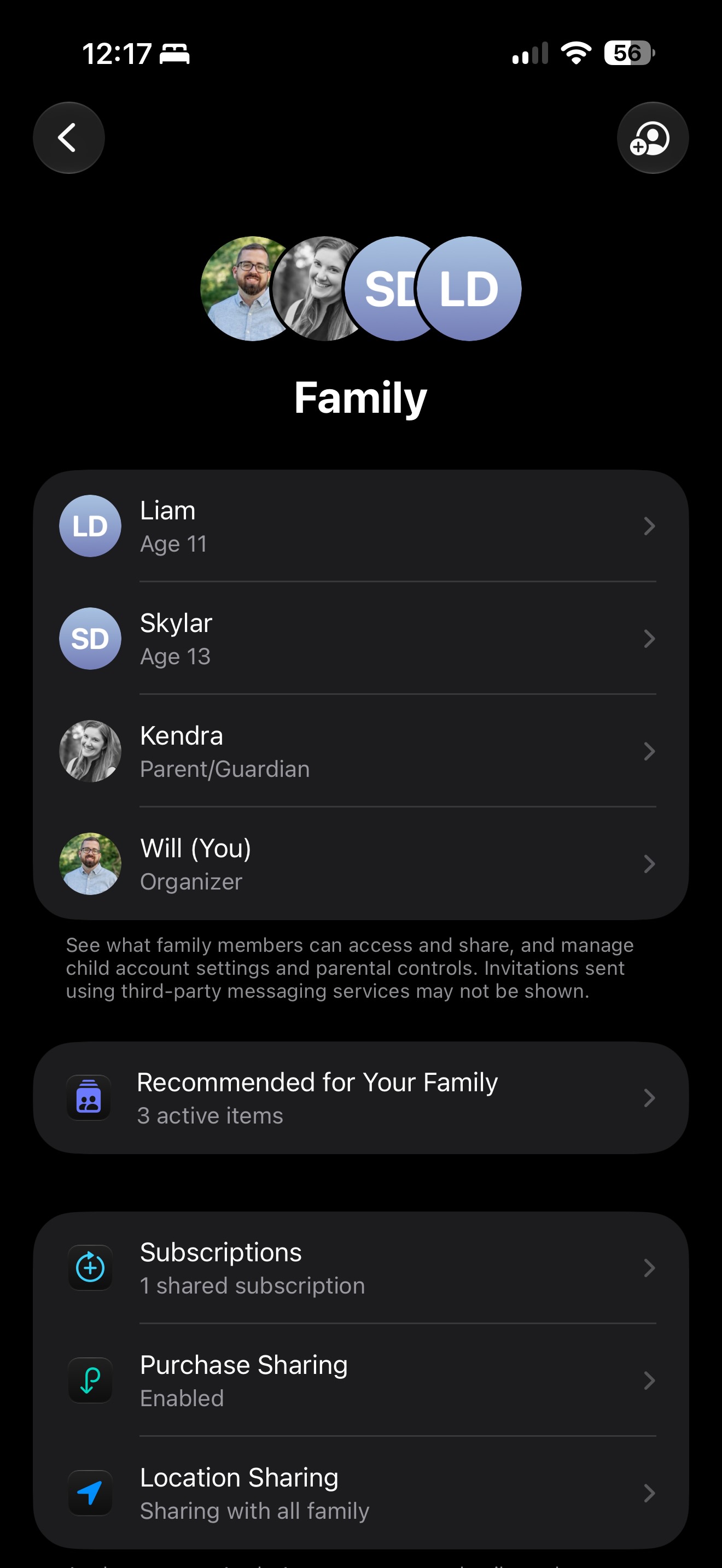
This step matters more than any other. Every control below depends on your teenager's account being part of your Family group. Without it, restrictions can be changed or removed from their own device.

Step 2: Turn On Screen Time and Set a Screen Time Passcode
  1. On your iPhone, go to Settings > Screen Time.
  2. Under the "Family" section, tap your teenager's name.
  3. If Screen Time is not already on, tap Turn On Screen Time, and follow the prompts, making sure you are setting it up as the parent.
  4. When prompted, create a four-digit Screen Time Passcode. This is separate from your teenager's device passcode.

[Screenshot: Screen Time passcode setup]

Do not use a birthday, "1234," or any code your teenager could guess. This passcode is what keeps them from changing or removing any setting you put in place.

Step 3: Enable Content and Privacy Restrictions

This is where you control what content is allowed on the device.

  1. Go to Settings > Screen Time, tap your teenager's name, then tap Content & Privacy Restrictions.
  2. Turn on Content & Privacy Restrictions.
  3. Tap iTunes & App Store Purchases to control installing, deleting, and in-app purchases.
  • Tap Content Restrictions to set age-appropriate limits for:
  • Movies, TV Shows, Apps, and Books (choose the appropriate rating for your teenager's age)
  • Web Content — select Limit Adult Websites at minimum, or Allowed Websites Only for stronger filtering
  • Music, Podcasts & News and explicit content filtering
  • Siri — restrict explicit language and web search results
  • Passcode Changes — set this to require your Screen Time passcode

[Screenshot: Content & Privacy Restrictions menu]
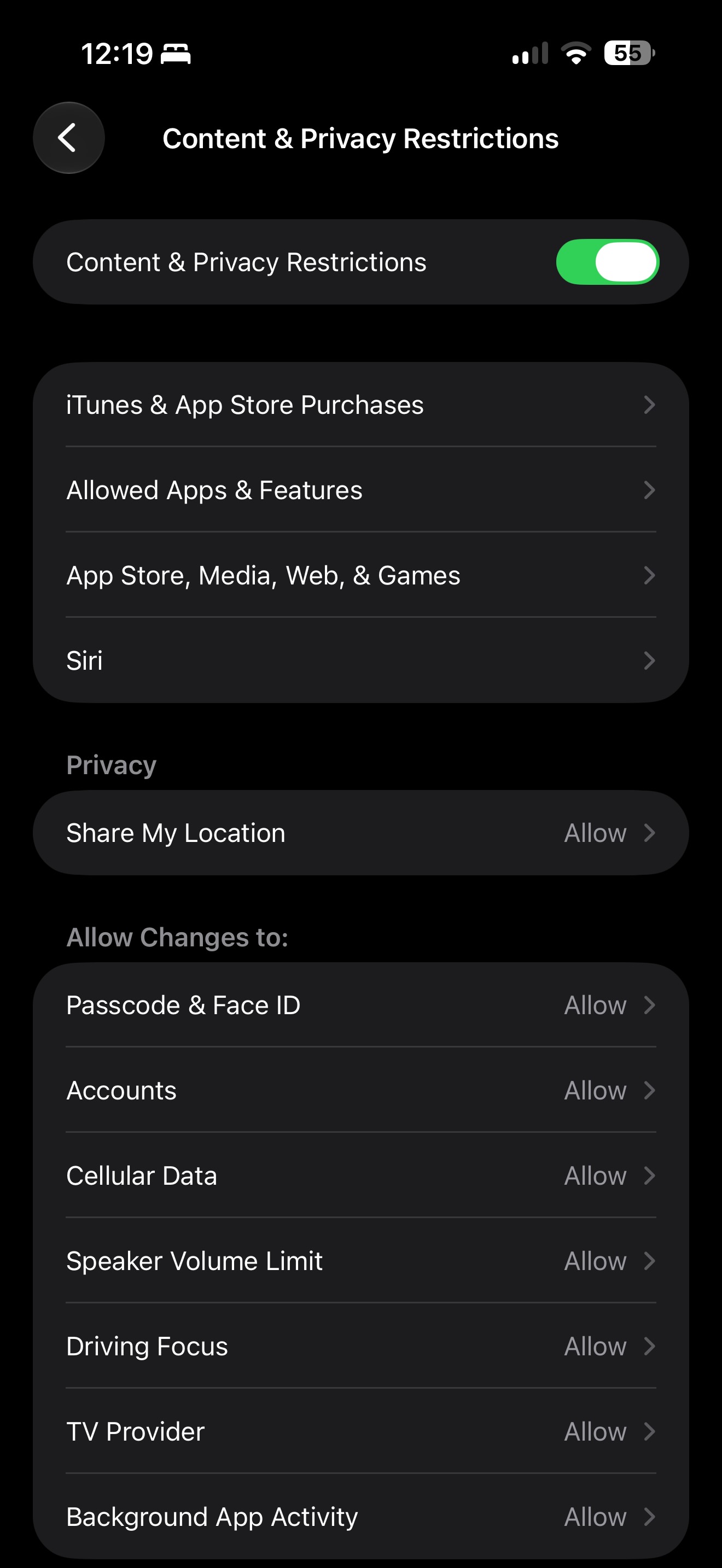
Suggested starting point: Set Movies, TV Shows, and Apps to G or PG, block explicit content under Music, Podcasts & News, set Web Content to at least Limit Adult Websites, and turn off explicit language and search results under Siri. This is a stricter baseline than Apple's own defaults, chosen to reflect the standard of purity Scripture calls us to guard our minds with:

Philippians 4:8
Finally, brethren, whatsoever things are true, whatsoever things are honest, whatsoever things are just, whatsoever things are pure, whatsoever things are lovely, whatsoever things are of good report; if there be any virtue, and if there be any praise, think on these things.

Families are free to adjust from here as they know their own household, but this is a sound and biblically consistent place to begin.

Step 4: Configure Communication Limits and Communication Safety
  1. From the same Screen Time menu for your teenager, tap Communication Limits.
  2. Choose who your teenager can call, message, or FaceTime with, and set separate rules for during Downtimehours.
  3. Return to Screen Time and look for Communication Safety (under Content & Privacy Restrictions or as its own menu depending on iOS version). Turn this on. It warns and blurs sensitive images sent or received in Messages and other supported apps, without alerting anyone outside the family.

[Screenshot: Communication Limits screen]

Step 5: Set Downtime and App Limits
  1. In Screen Time, tap Downtime and schedule hours when only phone calls and apps you allow will be available — a strong recommendation is overnight hours and during family or church time.
  2. Tap App Limits, then Add Limit, and choose categories such as Social Networking, Games, or Entertainment to set daily time budgets.
  3. Under Always Allowed, choose which apps (such as Phone, Messages, or a Bible app) remain available even during Downtime.

[Screenshot: Downtime and App Limits screens]

Suggested starting point: Set Downtime for 9:00 PM to 7:00 AM as a general common-sense window, adjusting for your family's own schedule, church commitments, and school demands. For App Limits, the categories most worth restricting are Social Networking, Games, and Entertainment/Streaming Video. The exact number of minutes is best left to each family, but limiting these three categories in particular will address where most unsupervised time tends to go.

Step 6: Turn On Ask to Buy
  1. Go to Settings > [your name] > Family.
  2. Tap your teenager's name, then turn on Ask to Buy.

This sends you a notification any time your teenager attempts to download an app or make a purchase, giving you the chance to approve or decline it.

Step 7: Turn On Location Sharing
  1. Go to Settings > [your name] > Family, tap your teenager's name, and enable Share My Location, or open the Find My app directly.

This is a safety measure, not a means of constant surveillance. It exists so that in an emergency, or simply out of ordinary parental care, you know where your child is.

Step 8: Lock the Settings Down

Return one more time to Screen Time > Content & Privacy Restrictions and confirm that Passcode Changesrequires your Screen Time passcode. This prevents your teenager from disabling anything you have just set up. Keep this passcode private, and do not store it in a note on a shared device.


A Word to Our Teenagers

If you are a teenager reading this, some of what your parents are setting up on your phone may feel restrictive, or even like they do not trust you. Please listen and understand: these limits are not a punishment, and they are not evidence that your parents think poorly of you. They are evidence that your parents love you and take seriously the responsibility God has given them to watch over you.

Proverbs 1:8-9
My son, hear the instruction of thy father, and forsake not the law of thy mother: for they shall be an ornament of grace unto thy head, and chains about thy neck.

Ephesians 6:1
Children, obey your parents in the Lord: for this is right.

Scripture is honest about the fact that there is real danger in this world, and much of it now arrives through a screen. The Bible describes an adversary who is active and watching for an opportunity:

1 Peter 5:8
Be sober, be vigilant; because your adversary the devil, as a roaring lion, walketh about, seeking whom he may devour.

That danger is not hypothetical.

  • Strangers online do not always present themselves honestly, and some intend real harm.
  • Pornography does lasting damage to the mind and to the conscience, and it is designed to be addictive.
  • Endless scrolling and comparison on social media are tied to real struggles with anxiety and discouragement among people your age.

None of these dangers announce themselves clearly before they do harm. That is exactly why a boundary set in advance, by someone who loves you, is worth more than a warning that comes too late.

When you are tempted to see a parental control as an obstacle, try to see it instead as a guardrail on a mountain road. It is not there because the road's engineers think you are a bad driver. It is there because the drop is real, and someone who cares about you decided you deserved protection before you needed it.

Trust your parents in this. Talk with them if a rule feels unclear or if you disagree, honestly and respectfully, rather than looking for ways around it. And above all, remember that ultimate safety and ultimate satisfaction were never found in unlimited access to anything a screen can offer. They are found in Christ.

Proverbs 3:5
Trust in the LORD with all thine heart; and lean not unto thine own understanding.


Questions about any of these settings can be directed to Bro. Nick Brunoni. Parents are also encouraged to review these settings together with their teenager rather than simply installing them without conversation, a boundary explained is far more likely to be respected than a boundary imposed in silence.

Up Next
From this Author: Will Duttry
October 1, 2026 • 8 Minute Read
Called to Serve: Assistant Pastors
Exodus 17:8-13; 24:13; 33:11; Numbers 27:18-23 Scripture gives us no single verse that defines the office of assistant pastor the way it defines the senior pastor or the deacon. Instead, God gives us something instructive, the lives of men who served faithfully alongside another. In the life of Moses, we find two pictures: Aaron and Hur, who held up his hands in battle, and Joshua, who was quietly shaped for leadership over many years. Together, they show us the two halves of this calling, sustaining the man God has placed over you, and being shaped by God in the process. Aaron & Hur: Holding Up the Hands Israel was under attack by Amalek at Rephidim. Moses sent Joshua down into the fight, while he himself climbed a hill overlooking the battle, staff in hand. Exodus 17:11 And it came to pass, when Moses held up his hand, that Israel prevailed: and when he let down his hand, Amalek prevailed As long as Moses' hands stayed lifted, Israel had the victory. But Moses was a man, and even a godly man's arms become heavy. Exodus 17:12 But Moses' hands were heavy; and they took a stone, and put it under him, and he sat thereon; and Aaron and Hur stayed up his hands, the one on the one side, and the other on the other side; and his hands were steady until the going down of the sun. What Aaron and Hur Teach Us 1) They held him up, they did not take his place. Aaron and Hur never reached for the staff. They did not step in to lead the battle or claim any credit for what God did that day. Their whole contribution was simply to keep Moses steady. This is the heart of what an assistant pastor does, he strengthens the man God has placed over him; he does not compete with him. 2) They noticed before they were asked. Nobody had to tell Aaron and Hur that Moses was struggling. They saw his hands growing heavy, and they acted. Much of faithful ministry is simply paying close enough attention to notice when your leader is growing weary, and stepping in before they ever have to ask. 3) Their work was not glamorous, but it mattered. No sermon was preached from that hilltop. No miracle was performed by Aaron or Hur. They simply held up arms until the sun went down. So much of this kind of ministry looks exactly like that - quiet, repetitive, tiring, and unnoticed by anyone watching from a distance. But without it, the battle would have been lost. 4) Their faithfulness on the hill won the battle in the valley. “And Joshua discomfited Amalek and his people with the edge of the sword” (Exodus 17:13). The fighting happened below, but the outcome was decided above, by men who refused to let tired arms decide the day. When those who assist a pastor stay faithful in quiet, unseen ways, the whole church benefits, even those who never once look up at the hill. This picture is not an isolated exception, it is a pattern God builds into how His people are meant to carry burdens. Ecclesiastes 4:9-10 Two are better than one; because they have a good reward for their labour. For if they fall, the one will lift up his fellow: but woe to him that is alone when he falleth; for he hath not another to help him up. And Paul commands the church at Galatia in words that could have been written about that very hillside: Galatians 6:2 Bear ye one another's burdens, and so fulfil the law of Christ. Assistant pastors live this out at the leadership level, but this is not only a pattern for pastors, it is a pattern for the whole church family. Someone near you is carrying heavy arms today. Joshua: The Minister Who Was Being Made Ready Long before Joshua ever led Israel into the promised land, his name shows up quietly, again and again, beside Moses. Scripture gives him a title easy to skim past, but worth considering - he is called Moses' “minister.” Exodus 24:13 And Moses rose up, and his minister Joshua: and Moses went up into the mount of God. One of the most telling verses about Joshua has nothing to do with leadership at all: Exodus 33:11 And the LORD spake unto Moses face to face, as a man speaketh unto his friend. And he turned again into the camp: but his servant Joshua, the son of Nun, a young man, departed not out of the tabernacle. Moses would meet with God and then return to the camp, but Joshua remained behind, alone, in the tabernacle. No one was watching. No assignment required it of him. He simply stayed in the presence of God because he loved being there. This is the kind of hidden faithfulness that shapes a man's heart long before God ever hands him something public to lead. What Joshua's Life Teaches Us 1) He was being shaped, not just used. Those years beside Moses were not only about getting things done. They were formation. God was quietly building within Joshua the character and dependence on God he would need decades later. If you are serving alongside leadership right now, this season is not wasted. Whether or not you are ever asked to lead publicly, God is building something in you that you will need later, even if you cannot see it yet. 2) Nearness to God matters more than nearness to the platform. Joshua's greatest qualification was not his skill in battle, it was that he lingered in the tabernacle. Time spent in prayer and in the Word, when no one is watching or applauding, is what makes public ministry bear fruit that lasts. 3) God's timing, not personal ambition, moved him forward. When it finally came time for Joshua to lead, it did not happen because he pushed for it: Numbers 27:18, 23 And the LORD said unto Moses, Take thee Joshua the son of Nun, a man in whom is the spirit, and lay thine hand upon him... And he laid his hands upon him, and gave him a charge, as the LORD commanded by the hand of Moses. The Lord directed it. Moses commissioned it publicly, before the whole congregation. And the people recognized it. Joshua never appointed himself, and he never campaigned for the role. This remains the pattern God honors today, leadership that comes through divine calling, not simply ambition. 4) Small, hidden faithfulness always comes first. Joshua served quietly beside Moses for roughly forty years before he ever led Israel across the Jordan. There is no shortcut in Scripture. God is patient, and He proves men in the small places long before He entrusts them with the large ones. When Moses finally laid his hands on Joshua, Scripture tells us exactly what resulted: Deuteronomy 34:9 And Joshua the son of Nun was full of the spirit of wisdom; for Moses had laid his hands upon him: and the children of Israel hearkened unto him, and did as the LORD commanded Moses. This wisdom did not appear in Joshua overnight, it was the fruit of years spent near Moses, watching him pray, watching him lead, watching him fail and repent and trust God again. This is exactly the pattern Paul later instructs Timothy to continue: 2 Timothy 2:2 And the things that thou hast heard of me among many witnesses, the same commit thou to faithful men, who shall be able to teach others also. Faithful men, teaching faithful men, who go on to teach others. This is not a modern leadership strategy, it is simply how God has always grown His church, one faithful life poured into another. A Challenge for All of Us Jesus captured what made Joshua ready long before Israel ever knew his name: Luke 16:10 He that is faithful in that which is least is faithful also in much: and he that is unjust in the least is unjust also in much. An assistant pastor's calling holds both of these truths together. Like Aaron and Hur, he is called to sustain, to notice weariness, to hold up tired hands, and to strengthen the man God has placed over him without ever seeking to replace him. And like Joshua, he is called to be shaped, to remain faithful in hidden, unseen places, trusting that God is building something in him for a purpose only the Lord fully sees. If you are serving in a supporting role right now, in pastoral ministry or anywhere else in this church, don’t be discouraged in the tent or weary in holding up the hands of another. The Lord is not wasting this season. Every one of you who serves faithfully where no one is watching is needed. Next in this series: How These Offices Work Together Available Thursday, October 8, 2026.
September 24, 2026 • 4 Minute Read
Called to Serve: The Deacons
The word “deacon” simply means servant, and that tells us a lot about the office before we read another verse. Our deacons are not just a governing board, and they are not a junior version of the pastorate. They are godly, spiritually qualified men, set apart to care for the real, practical needs of this church family, so your pastor can remain devoted to prayer and the ministry of the Word on your behalf. Where This Calling Began The office of deacon grew out of a real problem in the early church. Widows were being overlooked in the daily distribution of food, and it grieved the congregation. Here is how the apostles responded: Acts 6:2-4 Then the twelve called the multitude of the disciples unto them, and said, It is not reason that we should leave the word of God, and serve tables... Wherefore, brethren, look ye out among you seven men of honest report, full of the Holy Ghost and wisdom, whom we may appoint over this business. But we will give ourselves continually to prayer, and to the ministry of the word. The apostles did not consider the physical needs of the widows unimportant, they considered those needs important enough to entrust to godly, Spirit-filled men, so they would be cared for well. And the result was remarkable: Acts 6:7 And the word of God increased; and the number of the disciples multiplied in Jerusalem greatly. When deacons serve faithfully, the preaching of God's Word goes forward unhindered. These two callings were never meant to compete with each other. They were designed to free each other for exactly what each was made to do. Godly Men, Not Just Willing Hands Paul lays out real qualifications for deacons in 1 Timothy 3:8-13, sober men, not double-tongued, not given to much wine, not greedy, holding the mystery of the faith in a pure conscience, tested and found blameless, faithful husbands who lead their homes well. Our deacons are not simply the men who happen to be available or willing to work, they are men whose character has already been proven. The trust placed in them is spiritual before it is ever practical. What Deacon Ministry Looks Like Caring for our members' physical needs, especially during illness, grief, or hardship Helping carry the practical, everyday operation of the church so your pastor is free for prayer and the Word Living as examples of godly character and faithful households within our congregation Standing ready to quietly meet needs as they become known, often without ever being asked Guarding the peace and unity of this church family alongside pastoral leadership The Example Christ Himself Set If our deacons ever wonder whether their service is truly significant, they need only remember whose example they are following. Jesus told His disciples plainly what greatness looks like in His kingdom: Matthew 20:26-28 But whosoever will be great among you, let him be your minister; And whosoever will be chief among you, let him be your servant: Even as the Son of man came not to be ministered unto, but to minister, and to give his life a ransom for many. Our Lord washed feet. He served in like manner long before He ever commissioned seven men to serve tables in Jerusalem. When a deacon serves quietly and without recognition, he is not doing lesser work, he is walking in the footsteps of Christ. Paul promises that this service is never wasted, even when no one else notices it: 1 Timothy 3:13 For they that have used the office of a deacon well purchase to themselves a good degree, and great boldness in the faith which is in Christ Jesus. Faithful service in this office does not go unnoticed by God, even on the days it goes unnoticed by everyone else. Why This Matters to You If a meal has ever appeared at your door during a hospital stay, if someone has ever quietly checked on you during a hard season, or helped you with something you did not even have to ask twice for, you have likely already seen deacon ministry at work. It is often hidden, but it is no less precious to this church family. Our deacons free your pastor to feed and watch the flock, and in doing so, they serve every one of us.Learn more about our current Deacons Next in this series: Assistant PastorsAssistant Pastors
September 17, 2026 • 5 Minute Read
Called to Serve: The Senior Pastor
Every church family looks to one man to carry the final weight of pastoral care, the senior pastor. This is not a position of convenience. It is a holy calling, and Scripture describes it in language that humbles the man who carries it and ought to deepen your love for him. Called to Feed and Watch When Paul left the elders at Ephesus, he gave them words that still define this calling today: Acts 20:28 Take heed therefore unto yourselves, and to all the flock, over the which the Holy Ghost hath made you overseers, to feed the church of God, which he hath purchased with his own blood. Feed and watch - this is the heart of the calling. A pastor feeds you through faithful, grounded preaching and teaching, week after week, so you are never left spiritually hungry. And he watches, aware of dangers you may not see, aware of the sheep who are struggling or straying, aware that every person sitting in that pew was purchased with the blood of Christ Himself. This is not a small thing to carry. Called to Give Account Peter, writing to fellow elders, describes this calling as both a privilege and a weight: 1 Peter 5:2-3 Feed the flock of God which is among you, taking the oversight thereof, not by constraint, but willingly; not for filthy lucre, but of a ready mind; Neither as being lords over God's heritage, but being ensamples to the flock. A true pastor never treats the flock as something he owns, the flock belongs to God. He leads by going first, not by just demanding others follow. And the writer of Hebrews adds a truth that ought to move us to pray earnestly for the men who shepherd us: Hebrews 13:17 They watch for your souls, as they that must give account. One day, your senior pastor will stand before God and give an account for how he cared for you. That is the weight behind every sermon prepared, every hospital room visited, and every hard conversation had in love, because he must care more about your soul than your comfort. A Calling Rooted in Love, Not Duty Before Jesus ever gave Peter a flock to feed, He asked him a question three times, and the order is worth noting: John 21:15 So when they had dined, Jesus saith to Simon Peter, Simon, son of Jonas, lovest thou me more than these? He saith unto him, Yea, Lord; thou knowest that I love thee. He saith unto him, Feed my lambs. Jesus did not ask Peter whether he was capable, trained, or confident. He asked whether Peter loved Him. Every faithful pastor's ministry flows from that same source, not duty first, but love for Christ first, and only then a love for His sheep that is willing to feed them, tend them, and feed them again (John 21:15-17). This is what truly qualifies a man to shepherd you. Paul calls this desire itself a good thing, not something to be ashamed of: 1 Timothy 3:1 This is a true saying, If a man desire the office of a bishop, he desireth a good work. It is good work, hard, humbling, and good. And it is work Paul says deserves our honor: 1 Timothy 5:17 Let the elders that rule well be counted worthy of double honour, especially they who labour in the word and doctrine. A Man Who Is Tested, Not Just Willing God does not leave the qualifications for this calling unclear. 1 Timothy 3:1-7 and Titus 1:5-9 lay them out in detail, a blameless life, sound doctrine, a well-ordered home, a good reputation even among those outside the church. This office is not granted because a man wants it or is willing to do it. It is granted to a man whose life and doctrine have been tested and found faithful, and whom the church itself recognizes and affirms. James reminds us why this bar is set so high: James 3:1 My brethren, be not many masters, knowing that we shall receive the greater condemnation. Teaching God's people carries a weightier judgment, not a lighter one. Your pastor does not step into a pulpit lightly, and he should not. Every time he opens the Word to you, he is aware that he will answer to God for what he says and how he lives. Why We Follow Gladly Submission to your pastor should never be seen as something forced or reluctant. Scripture calls us to follow willingly, because he watches for our souls and will answer to God for how he shepherded us. That is not a burden, it is a gift. Take a moment this week to thank the Lord for the pastor He has given you, and pray that God would strengthen him for the weight he carries on your behalf. Next in this series: The DeaconsCalled to Serve: The Deacons
September 13, 2026 • 2 Minute Read
Grandparents Day at Faith Baptist
Some gifts skip a generation. Others are meant to be passed down. On Sunday, September 13, 2026, our whole church family will pause together to give thanks for one of God's most precious gifts, the heritage of faith carried from one generation to the next. The Psalmist wrote, "One generation shall praise thy works to another, and shall declare thy mighty acts" (Psalm 145:4). That is the heartbeat of Grandparents Day at Faith Baptist. Faith is not meant to end with us. It is meant to be spoken, modeled, and handed down. Scripture reminds us how important it is: Proverbs 17:6 Children's children are the crown of old men; and the glory of children are their fathers. 2 Timothy 1:5 I call to remembrance the unfeigned faith that is in thee, which dwelt first in thy grandmother Lois, and thy mother Eunice; and I am persuaded that in thee also. Timothy's faith did not begin with him. It was planted by a grandmother, watered by a mother, and it grew into a life the Lord used greatly. That same kind of legacy is being written in homes across our church family right now, whether through a grandparent who walked faithfully before you, or grandchildren who remind you why it all matters. Weren’t able to make it? On Grandparents Sunday, we were reminded that every generation leaves something behind for the generation that follows—but the greatest inheritance we can give is not wealth, possessions, or earthly success, but a genuine faith in God. From Deuteronomy 6:1–12, we learn that generations must remember God, repeat His truth, reflect His truth in daily life, and guard against forgetting Him when His blessings bring comfort and prosperity. Our faith cannot simply be “Grandpa’s religion” or “Mom and Dad’s convictions”; it must be personally known, faithfully lived, and intentionally passed to those coming behind us. As we consider what we are leaving behind, may we remember what God has done, live according to His Word, and diligently teach the next generation to know and follow Him.Generations that Remember God
September 10, 2026 • 5 Minute Read
Called to Serve: Why Church Leadership Matters
From the very first churches in the book of Acts, God gave His people men who were called and equipped in specific ways to walk alongside and lead them. God loves us too much to leave us untended. Paul opens his letter to the church at Philippi with a line that is easy to read past, until we slow down and let it sink in: Philippians 1:1 Paul and Timotheus, the servants of Jesus Christ, to all the saints in Christ Jesus which are at Philippi, with the bishops and deacons. Paul does not simply greet “the church.” He greets the saints, and then he names the men God had placed among them, bishops (another word for pastors) and deacons. From the earliest days of the church, God's people were never meant to be a crowd without shepherds. We were meant to be a family, intentionally led and cared for. Two Offices Scripture gives us two offices in a local church, pastor and deacon. The pastor is referenced by different names throughout scripture, the bishop, elder, or overseer. They all reference the same calling while describing the role from a few different angles. Both offices carry qualifications God laid out for us in His Word (1 Timothy 3:1-13; Titus 1:5-9), and both exist for the same reason: to love and care for you. Your pastor is given to the ministry of the Word and prayer - feeding you, watching over your soul, and one day giving an account to God for how he shepherded you (Acts 20:28; Hebrews 13:17). Your deacons are given to practical, hands-on service - making sure needs are met, so your pastor can stay devoted to prayer and the Word on your behalf (Acts 6:1-4). Sometimes a church is blessed with more than one man serving in pastoral ministry. A senior pastor may have serving alongside him one or more assistant pastors. This is not a group of men dividing loyalty or competing for influence. They serve together, under one leader, for the sake of the gospel. A Promise Kept This pattern did not begin with Paul in the New Testament, it was a promise God made long before. Through the prophet Jeremiah, the Lord looked ahead to how He would care for His people: Jeremiah 3:15 And I will give you pastors according to mine heart, which shall feed you with knowledge and understanding. Pastors according to His heart, not according to ours. These are not men chosen by our own standards of charisma or ability, but men shaped after God's own heart for His people. And this was not a one-time gift to a single congregation. Wherever the gospel took root in the book of Acts, the same pattern followed: Acts 14:23 And when they had ordained them elders in every church, and had prayed with fasting, they commended them to the Lord, on whom they believed. Every church - not only the large ones, not only the ones in the great cities. Paul and Barnabas did not consider their work finished until godly men were in place to shepherd what God had started. The same care is taken here. These men are not given to us simply to keep the doors open. Paul tells the Ephesians exactly why Christ gives a church pastors and teachers: Ephesians 4:11-12 And he gave some, apostles; and some, prophets; and some, evangelists; and some, pastors and teachers; For the perfecting of the saints, for the work of the ministry, for the edifying of the body of Christ. The purpose is not to keep leadership occupied, it is to equip you. Your pastors are not meant to carry out all the ministry of this church alone while the rest of us watch. They are given to prepare you for the work God has for you, so that this whole body is built up together. Why This Matters to You This is not just about organizational structure. This is personal. This is God's own provision for His people. He never intended for you to walk through hard seasons, quiet doubts, or ordinary weeks without someone watching over you, and without someone ready to help when a need arises. Church leadership exists because God loves this church, and He has made loving provision for how we are shepherded and served. Over the next several weeks, this series will walk through what it means to have a senior pastor, what an assistant pastor's calling looks like, what a deacon's calling looks like, and how all of these callings work together toward one purpose: connecting you to Christ, growing you in His truth, and leading you to commit your life fully to the Savior. Next in this series: The Senior Pastor The weight your senior pastor carries - and why he carries it gladly. Available Thursday, September 17, 2026.
Currently Reading
September 3, 2026 • 10 Minute Read
Guarding the Gate
This post covers current iOS 26 Screen Time steps (verified against Apple's published settings paths as of August 2026). Apple has previewed additional Screen Time features arriving with iOS 27 this fall; once that update is live, this guide should be revisited. Proverbs 4:23 Keep thy heart with all diligence; for out of it are the issues of life. Psalm 101:3 I will set no wicked thing before mine eyes. Why These Safeguards Matter The teenage years are some of the most important years of spiritual and emotional formation in a young person's life. A teenager's convictions are being tested, their identity is being shaped, and their sense of right and wrong is being formed by everything that has access to their eyes, ears, and mind. During these years, the mind is still developing the capacity for self-control and long-term judgment, even while the desire for independence is growing quickly. That gap between growing freedom and growing wisdom is exactly where a smartphone becomes either a tremendous help or a serious danger. An iPhone in a teenager's pocket is not a neutral object. It is a door. Through that door can come sound Bible teaching, encouraging communication with godly friends, and useful tools for school and ministry. But through that same door can also come pornography, predatory strangers, cruel words from peers, hours of wasted time, and a steady stream of worldly messages about identity, beauty, and worth that contradict the truth of God's Word. Scripture places the primary responsibility for this kind of guarding on parents. Ephesians 6:4 And, ye fathers, provoke not your children to wrath: but bring them up in the nurture and admonition of the Lord. Proverbs 22:6 Train up a child in the way he should go: and when he is old, he will not depart from it. Parental controls are not a lack of trust in your teenager. They are one practical way of fulfilling the charge God has given parents to nurture, protect, and train. A wise farmer builds a fence before he needs one. A wise parent sets a boundary before it is tested. Setting up these tools now, and explaining calmly why they are in place, is an act of love and shepherding, not suspicion. The instructions below will walk you through every major parental control currently available on iOS, step by step. Setting Up Parental Controls on iOS (Step-by-Step) These steps use Apple's built-in Screen Time and Family Sharing tools, which are free and do not require any third-party app. Plan on fifteen to twenty minutes to complete the full setup. You will need your own iPhone and access to your teenager's Apple ID. Suggested Starting Settings At a Glance The starting points below reflect a standard consistent with our church's convictions on media and worldliness. Every family may adjust from here, but this is a sound place to begin. Suggested Starting Point Movies, TV Shows, Apps - G or PG only Music, Podcasts & News - Block explicit content Web Content - Limit Adult Websites (or Allowed Websites Only for stronger filtering) Downtime - 10:00 PM – 7:00 AM App Limits - Set limits on Social Networking, Games, and Entertainment/Streaming Video The detailed steps below show exactly where to enter each of these. Step 1: Set Up Family Sharing Family Sharing links your teenager's Apple Account to yours so that every setting below can be managed from your own phone, not theirs. On your iPhone, open Settings. Tap your name at the top, then tap Family (on some devices this appears as Family Sharing). Tap Add Member, then follow the prompts to add your teenager, either by inviting their existing Apple ID or creating a new one for them. Confirm your teenager now appears listed under your Family group. [Screenshot: Settings > Family screen] This step matters more than any other. Every control below depends on your teenager's account being part of your Family group. Without it, restrictions can be changed or removed from their own device. Step 2: Turn On Screen Time and Set a Screen Time Passcode On your iPhone, go to Settings > Screen Time. Under the "Family" section, tap your teenager's name. If Screen Time is not already on, tap Turn On Screen Time, and follow the prompts, making sure you are setting it up as the parent. When prompted, create a four-digit Screen Time Passcode. This is separate from your teenager's device passcode. [Screenshot: Screen Time passcode setup] Do not use a birthday, "1234," or any code your teenager could guess. This passcode is what keeps them from changing or removing any setting you put in place. Step 3: Enable Content and Privacy Restrictions This is where you control what content is allowed on the device. Go to Settings > Screen Time, tap your teenager's name, then tap Content & Privacy Restrictions. Turn on Content & Privacy Restrictions. Tap iTunes & App Store Purchases to control installing, deleting, and in-app purchases. Tap Content Restrictions to set age-appropriate limits for: Movies, TV Shows, Apps, and Books (choose the appropriate rating for your teenager's age) Web Content — select Limit Adult Websites at minimum, or Allowed Websites Only for stronger filtering Music, Podcasts & News and explicit content filtering Siri — restrict explicit language and web search results Passcode Changes — set this to require your Screen Time passcode [Screenshot: Content & Privacy Restrictions menu] Suggested starting point: Set Movies, TV Shows, and Apps to G or PG, block explicit content under Music, Podcasts & News, set Web Content to at least Limit Adult Websites, and turn off explicit language and search results under Siri. This is a stricter baseline than Apple's own defaults, chosen to reflect the standard of purity Scripture calls us to guard our minds with: Philippians 4:8 Finally, brethren, whatsoever things are true, whatsoever things are honest, whatsoever things are just, whatsoever things are pure, whatsoever things are lovely, whatsoever things are of good report; if there be any virtue, and if there be any praise, think on these things. Families are free to adjust from here as they know their own household, but this is a sound and biblically consistent place to begin. Step 4: Configure Communication Limits and Communication Safety From the same Screen Time menu for your teenager, tap Communication Limits. Choose who your teenager can call, message, or FaceTime with, and set separate rules for during Downtimehours. Return to Screen Time and look for Communication Safety (under Content & Privacy Restrictions or as its own menu depending on iOS version). Turn this on. It warns and blurs sensitive images sent or received in Messages and other supported apps, without alerting anyone outside the family. [Screenshot: Communication Limits screen] Step 5: Set Downtime and App Limits In Screen Time, tap Downtime and schedule hours when only phone calls and apps you allow will be available — a strong recommendation is overnight hours and during family or church time. Tap App Limits, then Add Limit, and choose categories such as Social Networking, Games, or Entertainment to set daily time budgets. Under Always Allowed, choose which apps (such as Phone, Messages, or a Bible app) remain available even during Downtime. [Screenshot: Downtime and App Limits screens] Suggested starting point: Set Downtime for 9:00 PM to 7:00 AM as a general common-sense window, adjusting for your family's own schedule, church commitments, and school demands. For App Limits, the categories most worth restricting are Social Networking, Games, and Entertainment/Streaming Video. The exact number of minutes is best left to each family, but limiting these three categories in particular will address where most unsupervised time tends to go. Step 6: Turn On Ask to Buy Go to Settings > [your name] > Family. Tap your teenager's name, then turn on Ask to Buy. This sends you a notification any time your teenager attempts to download an app or make a purchase, giving you the chance to approve or decline it. Step 7: Turn On Location Sharing Go to Settings > [your name] > Family, tap your teenager's name, and enable Share My Location, or open the Find My app directly. This is a safety measure, not a means of constant surveillance. It exists so that in an emergency, or simply out of ordinary parental care, you know where your child is. Step 8: Lock the Settings Down Return one more time to Screen Time > Content & Privacy Restrictions and confirm that Passcode Changesrequires your Screen Time passcode. This prevents your teenager from disabling anything you have just set up. Keep this passcode private, and do not store it in a note on a shared device. A Word to Our Teenagers If you are a teenager reading this, some of what your parents are setting up on your phone may feel restrictive, or even like they do not trust you. Please listen and understand: these limits are not a punishment, and they are not evidence that your parents think poorly of you. They are evidence that your parents love you and take seriously the responsibility God has given them to watch over you. Proverbs 1:8-9 My son, hear the instruction of thy father, and forsake not the law of thy mother: for they shall be an ornament of grace unto thy head, and chains about thy neck. Ephesians 6:1 Children, obey your parents in the Lord: for this is right. Scripture is honest about the fact that there is real danger in this world, and much of it now arrives through a screen. The Bible describes an adversary who is active and watching for an opportunity: 1 Peter 5:8 Be sober, be vigilant; because your adversary the devil, as a roaring lion, walketh about, seeking whom he may devour. That danger is not hypothetical. Strangers online do not always present themselves honestly, and some intend real harm. Pornography does lasting damage to the mind and to the conscience, and it is designed to be addictive. Endless scrolling and comparison on social media are tied to real struggles with anxiety and discouragement among people your age. None of these dangers announce themselves clearly before they do harm. That is exactly why a boundary set in advance, by someone who loves you, is worth more than a warning that comes too late. When you are tempted to see a parental control as an obstacle, try to see it instead as a guardrail on a mountain road. It is not there because the road's engineers think you are a bad driver. It is there because the drop is real, and someone who cares about you decided you deserved protection before you needed it. Trust your parents in this. Talk with them if a rule feels unclear or if you disagree, honestly and respectfully, rather than looking for ways around it. And above all, remember that ultimate safety and ultimate satisfaction were never found in unlimited access to anything a screen can offer. They are found in Christ. Proverbs 3:5 Trust in the LORD with all thine heart; and lean not unto thine own understanding. Questions about any of these settings can be directed to Bro. Nick Brunoni. Parents are also encouraged to review these settings together with their teenager rather than simply installing them without conversation, a boundary explained is far more likely to be respected than a boundary imposed in silence.

September 3, 2026 • 4 Minute Read
Faithful Over a Few Things
Faith Baptist Christian Academy is not the only place where children at Faith Baptist Church are being taught week by week. Every Sunday morning and Wednesday night, a faithful group of teachers and helpers gives up their personal time to make preparation to patiently serve in our Faith Kids classrooms. In our recent Worker Training we were from the parable of the talents in Matthew 25. Matthew 25:14-15 For the kingdom of heaven is as a man travelling into a far country, who called his own servants, and delivered unto them his goods. And unto one he gave five talents, to another two, and to another one; to every man according to his several ability; and straightway took his journey. The point of the parable is simple. The talents did not belong to the servants. They belonged to the master. The servants were stewards, not owners, entrusted with something for a season. In the same way, none of our Faith Kids workers own the children in their classrooms, the rooms they use, or the gospel they teach. All of it belongs to the Lord, and all of it has been placed in their hands to manage faithfully. Three areas of stewardship were laid before our workers that evening. Steward the Opportunity to Teach and Influence Children Every child who walks into a Faith Kids classroom belongs to the Lord first, and to their parents second. For some of these children, the hour spent in that classroom may be the only spiritual input they receive all week. That is a sobering thought, and it means preparation matters. Coming ready to teach, ready to love, and ready to notice the child who is struggling or has never heard the gospel is not optional. It is the calling. 1 Corinthians 4:2 Moreover it is required in stewards, that a man be found faithful. Steward the Church's Property and Resources Faith Kids classrooms are shared spaces, used by other ministries and by the Christian Academy throughout the week. Stewardship does not end when class is dismissed. It extends to the next person who walks through that door. Psalm 24:1 The earth is the LORD's, and the fulness thereof; the world, and they that dwell therein. We are challenged to leave every room better than they found it, remembering that even picking up crayons from the floor can be done as unto the Lord. Colossians 3:23 And whatsoever ye do, do it heartily, as to the Lord, and not unto men. Steward the Gospel Itself The highest stewardship of all is the gospel. No craft, snack, or game carries the weight of the message that can change a child’s eternal destination. 1 Thessalonians 2:4 But as we were allowed of God to be put in trust with the gospel, even so we speak; not as pleasing men, but God, which trieth our hearts. We are reminded that it is possible to run a fun, well-organized class and never once clearly present the cross of Christ. Every lesson should carry a clear gospel thread: that all are sinners, that Christ died for sin and rose again, and that salvation comes by grace through faith in Him alone. A Closing Word Faithful stewardship also means guarding the integrity of the ministry itself. We are reminded to never be alone with a child in a closed room, not out of distrust, but so that this ministry remains above reproach. A faithful steward refuses to put himself, the child, or this ministry into a position where he could be falsely accused, or where sin could ever find an opening. Proverbs 4:23 Keep thy heart with all diligence; for out of it are the issues of life. None of our Faith Kids workers are seeking recognition. But they are seeking to hear these words spoken over them one day. Matthew 25:21 His lord said unto him, Well done, thou good and faithful servant: thou hast been faithful over a few things, I will make thee ruler over many things: enter thou into the joy of thy lord. Please pray for our Faith Kids workers as they faithfully steward the children, the resources, and the gospel entrusted to them each week.Interested in serving in Faith Kids?
September 1, 2026 • 3 Minute Read
Five Things to Pray for Our Church This Month
September is a busy month at Faith Baptist Church. New ministries are launching, our school is opening its doors, and opportunities to reach our community are on the calendar. None of this bears lasting fruit apart from the Lord's blessing on it. Below are five specific things happening this month, along with specific ways you can pray for each one. 1) GriefShare Begins Tonight at 7:00 PM Tonight marks the launch of our new GriefShare ministry, a place of comfort and biblical hope for those walking through the loss of a loved one. Pray that those who are hurting would find their way through the door tonight. Pray for the group facilitators, that they would minister with compassion and point every participant to the comfort found only in Christ. Pray for group members to feel safe enough to open up and begin the healing process. Pray that this ministry would be a means of showing Christ's love to our community.Learn more about GriefShare 2) Faith Baptist Christian Academy Opens September 3 Faith Baptist Christian Academy begins its new school year on Wednesday, September 3, with 113 students currently enrolled. Pray for each child to be tender toward the things of God as they begin the year. Pray for our teachers and staff, for wisdom and patience as they lead our students. Pray for smooth transitions on opening day, particularly for new families and younger students. Pray that the Academy would remain a strong instrument for raising children in the nurture and admonition of the Lord. 3) Grandparents Day — Sunday, September 13 at 11:00 AM We will honor and celebrate the legacy of our church family during our morning service. Pray for grandparents to experience the appreciation of our church family that morning. Pray for grandchildren to be encouraged to invite their grandparents to attend. Pray that the Lord would use this day to strengthen the spiritual legacy passed from one generation to the next. Pray for salvation among any unsaved grandparents or grandchildren who may be present.Read our Grandparents Day Post 4) Master Clubs Relaunches — Wednesday, September 16 Master Clubs returns this month under new leadership, continuing its work of discipling children in the Word of God. Pray for Bro. Brad and Jaime O'Dell as they step into leadership, asking the Lord for wisdom, vision, and endurance. Pray for a strong team of workers to come alongside them. Pray for children to attend and for the gospel to take root. Pray for smooth logistics as the ministry gets up and running.Learn more about Master ClubRegister your Children 5) Friend Day — Sunday, September 20 Friend Day gives every member of our church family the opportunity to bring someone who needs Christ and needs a church home. Pray for boldness as members invite friends, neighbors, co-workers, and family members. Pray for the Holy Spirit to prepare the hearts of those who are invited before they ever walk through the door. Pray for clear gospel preaching that morning, resulting in souls saved. Pray for guests to feel welcome and to want to return.Download an Invitation to Share! James 5:16 The effectual fervent prayer of a righteous man availeth much. Would you commit to praying over these five requests this month? The Lord delights to work through the prayers of His people. Let us seek Him earnestly for our church, our school, and our community.
August 18, 2026 • 5 Minute Read
A Bag with Holes
Haggai 1:6 He that earneth wages earneth wages to put it into a bag with holes. There is a kind of financial frustration that is almost exclusive to those who follow God. It is the frustration of a person who works hard, gives to the Lord, and still cannot seem to get ahead. The harvest never quite matches the labor. The wages disappear before the month is out. There is always more month than money. And somewhere underneath the stress is a nagging question: Why isn't God blessing this? Haggai had a word for people who felt exactly that way. The returned remnant of Israel wasn't lazy. They weren't godless. They were back in the land, going through the motions of religious life, and their finances were still leaking. God put His finger on the reason: their priorities were disordered. They had been so focused on their own houses that they had neglected His. And the result was a bag full of holes, labor that produced nothing lasting, wages that vanished as fast as they came. It is worth asking whether the same diagnosis might apply closer to home. Start with the tithe. If you are not tithing, giving a faithful, intentional ten percent to the Lord through your local church, this is a direct and loving challenge to begin. Not because God is in need. "For every beast of the forest is mine, and the cattle upon a thousand hills." (Psalm 50:10) He is not waiting on your contribution to balance His books. But He has ordained the tithe as an act of worship and an exercise of faith, it is a regular declaration that He is Lord over everything you earn, and He blesses the obedience of His people who take Him at His word. In Malachi 3:10, God extends an invitation: "Bring ye all the tithes into the storehouse, that there may be meat in mine house, and prove me now herewith, saith the LORD of hosts, if I will not open you the windows of heaven, and pour you out a blessing, that there shall not be room enough to receive it." That is the only place in Scripture where God says to His people: test Me. He is not offended by your uncertainty. He is simply calling your bluff, inviting you to step out in obedience and see what He does. We are not under the Mosaic law. We stand under grace. But grace never lowers the bar, it lifts the heart toward it. If a tenth was the starting point for God's Old Testament people, what does it say about New Testament believers, who have seen the full revelation of Calvary, if they give less? Those who understand what Christ has done are not looking for the minimum, they are looking for ways to give more. So let this be a straightforward challenge: tithe. Give your tithe this Sunday. Give it next Sunday. Make it the first thing you do with what God provides, not the last. Honor Him with the firstfruits, not the remainder. But the tithe is the beginning, not the end. This is where I must be honest with you. A man can tithe faithfully on Sunday and dishonor God financially the rest of the week. He can put 10% in the plate and spend the other 90% in ways that reflect no prayer, no planning, no biblical conviction whatsoever, driven by impulse, shaped by covetousness, burdened by debt he did not have to carry. And then wonder why the bag still has holes. Here is the truth that biblical stewardship demands we recognize: the other 90% belongs to God too. Every dollar that passes through your hands, given, spent, or saved, is the Lord's money being managed by the Lord's servant. The tithe is an act of worship. But stewardship is a whole-life conviction. It covers the budget you make or refuse to make. The debt you take on or choose to avoid. The way you spend, the discipline with which you save, and the contentment, or lack of it, that drives your financial decisions day to day. 1 Corinthians 4:2 Moreover it is required in stewards, that a man be found faithful. God is not looking for financial success. He is looking for faithfulness. And faithfulness with money means holding all of it with an open hand, managing it with the same intentionality and prayerfulness you bring to the offering, because it all came from Him, it all belongs to Him, and you will give an account for all of it. So here is the full challenge: Tithe. Do it consistently, do it cheerfully, do it in faith, and trust God with the results. And then carry that same conviction into the rest of your financial life. Build a budget. Get out of debt. Spend with purpose. Save with wisdom. Ask before every major decision: Am I being a faithful steward of what God has entrusted to me? The goal is not a bigger bank account. The goal is a freer heart, one that holds money loosely because the question of ownership has already been settled. When you've acknowledged that it all belongs to Him, the anxiety of grasping loosens its grip. Contentment becomes possible. Generosity becomes natural. That is what God is after. Not a portion of your paycheck. All of you, surrendered, trusting, and faithful with everything He's placed in your hands. The windows of heaven are worth finding out about. Take Him up on it. Questions about biblical stewardship? We'd love to walk through it with you. Join us Sunday at Faith Baptist ChurchPlan a Visit
August 7, 2026 • 4 Minute Read
Keeping the Spotlight on Christ
The piano is tuned, every word rehearsed, every voice ready, and still, the most important question a worship team member can ask has nothing to do with sound. Who is this for? Worship Is More Than Singing When most people hear the word "worship," they think of the songs sung before the sermon. But worship is much more than that. Singing, preaching, praying, and giving are all acts of worship, and every one of them can be offered to God in sincerity, or to self in pride. A pastor can study over a sermon to be admired for his insights rather than to feed the flock God has entrusted him with. A giver can drop an offering in the plate to be seen as generous rather than out of love for the Lord, a danger Christ addressed directly: Matthew 6:1 Take heed that ye do not your alms before men, to be seen of them: otherwise ye have no reward of your Father which is in heaven. A worshipper can lift hands or sing loudly not from a heart stirred by God, but from a desire to appear spiritual to those nearby. Wherever a person serves in worship, pulpit, platform, offering plate, or the seat, the same temptation is there: to turn an act meant for God into a performance for man. John the Baptist stood at the peak of his ministry, with crowds gathering and people following, and said this of Christ: John 3:30 He must increase, but I must decrease. That single sentence defines the calling of every person who serves on a platform. Any Ministry that puts attention on the servant instead of the Savior has already missed the point. The Danger of a Watching Crowd Scripture warns plainly about the pull toward performing for people rather than for God. In John 12, even some of the chief rulers believed on Christ, yet would not confess Him openly: John 12:43 For they loved the praise of men more than the praise of God. A worship team stands in a uniquely exposed position. There is a congregation watching, a sound system amplifying, and a camera live streaming. None of that is wrong in itself, but it creates real temptation to serve the eyes in the room rather than the throne of God. The desire to be noticed or complimented can quietly replace the desire to glorify Christ, and the shift rarely announces itself. It creeps in through small compromises, a note held for effect rather than for the Lord, a subtle seeking of praise from people that outweighs the joy of pleasing God. The Standard Is the Heart, Not the Performance When Samuel was sent to anoint a king, he was reminded of an unchanging truth: 1 Samuel 16:7 For the LORD seeth not as man seeth; for man looketh on the outward appearance, but the LORD looketh on the heart. A congregation can only judge the outward appearance, tone, timing, technique. God alone judges the heart behind it. A technically flawless song offered in pride is not acceptable worship. A simple song offered in humility, aimed entirely at the glory of God, is. Paul gives the team the standard that settles every motive question: 1 Corinthians 10:31 Whether therefore ye eat, or drink, or whatsoever ye do, do all to the glory of God. Keeping the Spotlight Where It Belongs Practical tips for the platform: Examine motive before rehearsal, not just during it. Ask privately whether preparation is aimed at excellence for God's glory or excellence for personal recognition. Refuse the compliment trap. Receive kind words graciously, but redirect the credit quickly and genuinely to the Lord. Guard against comparison. Comparing gifting, placement, or attention with other team members feeds pride and steals joy from service. Remember the unseen Audience. The congregation may never know the difference between worship and performance, but God always does. David wrote plainly: Psalm 115:1 Not unto us, O LORD, not unto us, but unto thy name give glory. This posture David is highlighting, should be present in every faithful servant from any stage. We offer our skills without reservation, surrender the credit without exception, and Christ alone is left standing in the spotlight.
July 30, 2026 • 7 Minute Read
What Does It Mean to Be a Church Member?
The word "membership" gets used for all kinds of things; gym memberships, subscription memberships. None of those come close to describing what it means to be a member of a local church. Church membership is not a card in your wallet or a name on a roll. It is a covenant commitment, made before God and before a body of believers, to walk together in the work of the gospel. At Faith Baptist Church, we believe church membership is an expression of a Christian's commitment to Christ and to the local church family. It reflects the pattern of the early church, where believers were devoted to one another in a way that went far beyond simply attending the same meeting. Membership is not a formality. It is a meaningful way of living out our faith together. Here is what that commitment looks like. We Commit to Attend Church Hebrews 10:25 Not forsaking the assembling of ourselves together, as the manner of some is; but exhorting one another: and so much the more, as ye see the day approaching. Acts 2:46 And they, continuing daily with one accord in the temple, and breaking bread from house to house, did eat their meat with gladness and singleness of heart, Faithful attendance is not about filling a seat. It is about showing up for one another, being present to encourage, to be encouraged, and to stand together as the day of the Lord draws near. We Commit to Care for One Another 1 Peter 4:8 And above all things have fervent charity among yourselves: for charity shall cover the multitude of sins. Romans 12:15 Rejoice with them that do rejoice, and weep with them that weep. Caring for one another is central to what it means to belong to a church family. This kind of care is best built in smaller settings, which is why joining a Bible Study class is such an important step for every member. We Commit to Serve 1 Corinthians 12:7 But the manifestation of the Spirit is given to every man to profit withal. Every member has been given spiritual gifts for the profit of the whole body. Membership is an invitation to use those gifts. During the membership interview, our pastoral staff and deacons are glad to talk through where you might serve and grow. We Commit to a Godly Life 1 Corinthians 6:9-11 Know ye not that the unrighteous shall not inherit the kingdom of God? Be not deceived: neither fornicators, nor idolaters, nor adulterers, nor effeminate, nor abusers of themselves with mankind, Nor thieves, nor covetous, nor drunkards, nor revilers, nor extortioners, shall inherit the kingdom of God. And such were some of you: but ye are washed, but ye are sanctified, but ye are justified in the name of the Lord Jesus, and by the Spirit of our God. We are called to live holy lives, not to earn favor with God, but because we have already been washed, sanctified, and justified. A holy life pleases God, helps our brothers and sisters, and brings honor to Christ. We Commit to Give Malachi 3:10 Bring ye all the tithes into the storehouse, that there may be meat in mine house, and prove me now herewith, saith the LORD of hosts, if I will not open you the windows of heaven, and pour you out a blessing, that there shall not be room enough to receive it. II Corinthians 9:7 Every man according as he purposeth in his heart, so let him give; not grudgingly, or of necessity: for God loveth a cheerful giver. The tithe gives us a starting point rooted in the Old Testament pattern. The New Testament calls us further still; to give cheerfully, generously, and sacrificially, not out of a sense of obligation, but out of love for the Lord. We Commit to Keep the Peace Ephesians 4:2-3 With all lowliness and meekness, with longsuffering, forbearing one another in love; Endeavouring to keep the unity of the Spirit in the bond of peace. Members are called to live out the gospel in their relationships with one another, choosing humility and patience over division, and unity over strife. We Commit to Pray Ephesians 6:18-20 Praying always with all prayer and supplication in the Spirit, and watching thereunto with all perseverance and supplication for all saints; And for me, that utterance may be given unto me, that I may open my mouth boldly, to make known the mystery of the gospel, For which I am an ambassador in bonds: that therein I may speak boldly, as I ought to speak. We hope every member is praying daily for Faith Baptist, and especially for other members and our pastoral staff. One of the best ways to grow in this is to join us for our weekly prayer meeting each Wednesday evening at 7:00 p.m. Not a Formality, but a Family Church membership at Faith Baptist is not about adding your name to a list. It is about joining a family, a body of believers who have committed together to attend, to care, to serve, to live godly lives, to give, to honor leadership, to keep peace, and to pray for one another. This is the pattern we see in the early church in the book of Acts, and it is the pattern we want to live out today. Who Can Become a Member? Membership at Faith Baptist is open to anyone who can testify to a personal relationship with Jesus Christ. Specifically, we ask every prospective member to affirm three things: A clear testimony of salvation - a credible profession of faith in Jesus Christ alone, by grace through faith, as the only way of salvation (Ephesians 2:8-9). Believer’s baptism by immersion - having been scripturally baptized by immersion following salvation, in obedience to Christ’s example (Matthew 3:16; Acts 8:36-39). If you have not yet been baptized this way, our pastoral staff would love to talk with you about that next step. Agreement with our Statement of Faith - a willingness to affirm what we believe the Bible teaches, as outlined in our church constitution, and to walk in unity with this local body under that agreed understanding of Scripture. Membership is not reserved for the mature believer or the lifelong church attender. It is for anyone the Lord has saved who is ready to commit to walking this road together with this church family. The Process of Membership A) Meet with a Staff Member The first step is simple: reach out to one of our Pastoral Staff. We will schedule a time to sit down together, hear your testimony of salvation, walk through what membership means, and answer any questions you have along the way.Learn more about what we Believe B) Meet with a Deacon Next, you’ll meet with one of our deacons. This conversation continues the process, giving you a chance to talk through your baptism, your walk with the Lord, and where you might serve and grow as part of this church family — and giving our deacons the opportunity to know you and pray for you as you take this step.Learn about our Deacons C) Publicly Join Once these conversations are complete, you’ll be presented to the church family and publicly received into membership — usually during a Sunday service. This is a joyful moment where the whole church gets to welcome you and commit, alongside you, to walk together in the work of the gospel. Interested in becoming a member? We would love to talk with you about taking this next step. Reach out to one of our Pastoral Staff, and we will schedule a time to hear your testimony and walk through what membership means together.Want to Join? Let's Talk!
July 27, 2026 • 4 Minute Read
Finding God’s Presence Through Grief
Isaiah 43:2 When thou passest through the waters, I will be with thee; and through the rivers, they shall not overflow thee: when thou walkest through the fire, thou shalt not be burned; neither shall the flame kindle upon thee. There are several words that stick out to me in this passage, the first one is not a word of comfort in the way we might first expect. The word is when. The Lord does not say, “If thou passest through the waters.” He does not offer a conditional promise, reserved only for those who might happen to face hardship. He speaks with certainty. The waters will come. The rivers will rise. The fire will burn. Believers are not exempt from grief and loss; they are a part of life in a world marked by sin. The context of Isaiah 43, God spoke this word to Israel in the hardship of exile, it reveals His character, that He does not abandon His people during trials but walks through it with them, is the same character He shows to every believer today. The Certainty of Grief Scripture never hides this reality from us. Job was a man described by God as perfect and upright, yet was not exempt from devastating loss. Job 14:1 Man that is born of a woman is of few days, and full of trouble. The Lord Jesus Christ Himself, though sinless, was not shielded from grief. He wept at the tomb of Lazarus, entering fully into the sorrow of those He loved. John 11:35 Jesus wept. If the Son of God was not exempt from grief, His people should not expect to either. The promise of Isaiah 43:2 is not that trouble will pass us by, but that when it comes, and it will, we do not face it alone. The Promise of Presence The second word worth noting in Isaiah 43:2 is through. God does not promise a detour around the waters or a shortcut past the fire. He promises to walk with us through them. This is not a passive presence but an active sustaining. The waters do not overflow. The flame does not kindle. Something is preserved in the midst of the trial, and that something is the soul of the believer, held fast by the hand of God. The psalmist understood this same truth when he wrote of walking through the darkest valley: Psalm 23:4 Yea, though I walk through the valley of the shadow of death, I will fear no evil: for thou art with me; thy rod and thy staff they comfort me. Notice again the word through. Not around. Not stuck within. Through. The valley has an end, and the Shepherd walks every step beside His sheep. A Present Help The Lord does not offer His presence only in joyful seasons. He identifies Himself as a refuge specifically during times of trouble. Psalm 46:1 God is our refuge and strength, a very present help in trouble. For the believer walking through grief today, whether from the loss of a loved one, the weight of a difficult situation, or sorrow that has no easy explanation, this promise stands firm. The waters have not overtaken you. The fire has not consumed you. The Lord who spoke this word to Israel is the same Lord who still upholds us now. A Place to Walk Through It Together Grief was never meant to be carried in isolation. Starting Tuesday, September 1, 2026, we will be launching a GriefShare ministry, a place where those walking through loss can find fellowship with others who understand, along with the steady hope found only in God’s Word.Learn more about GriefShare